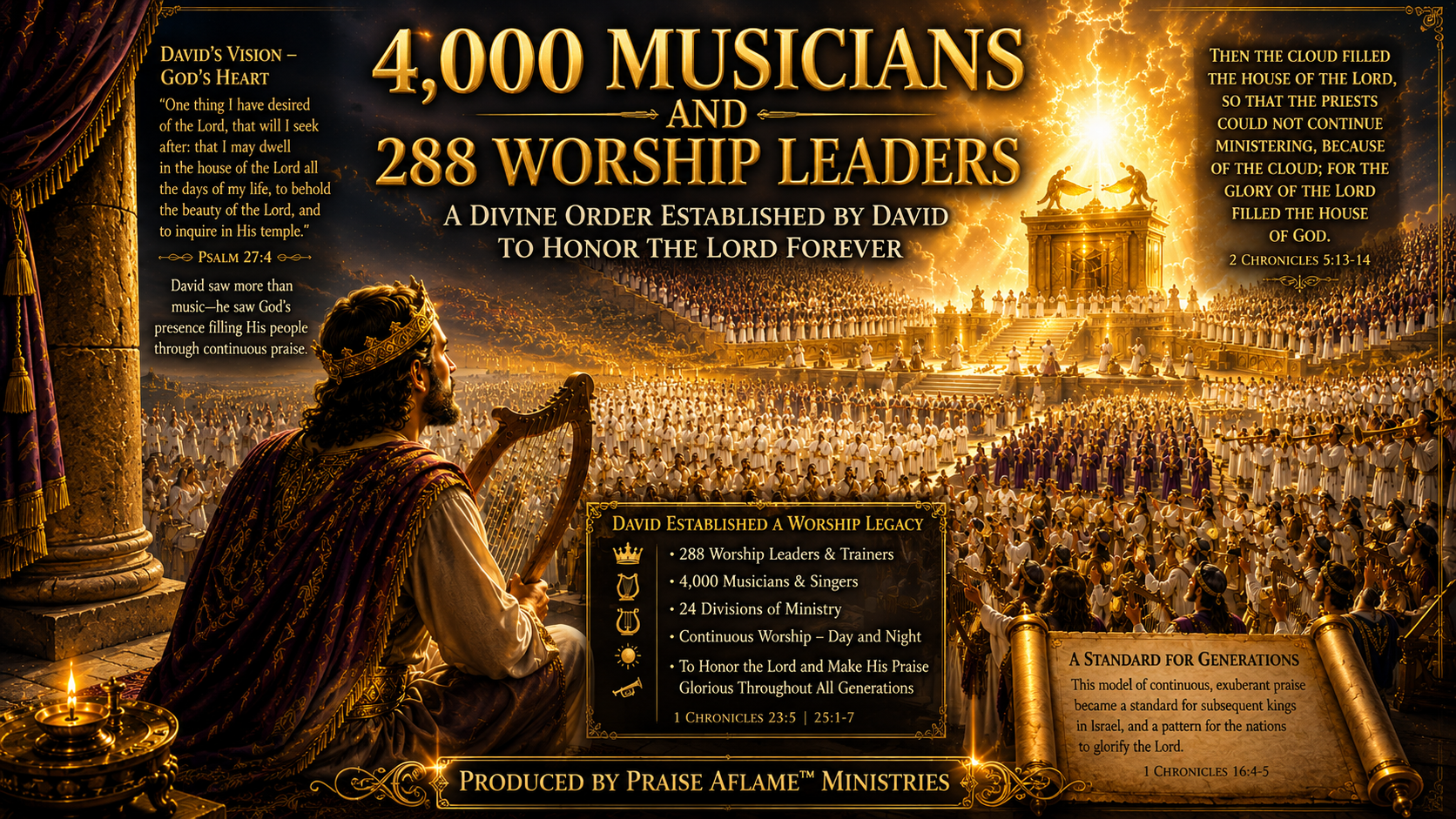
4,000 Musicians and 288 Worship Leaders
Uncovering the scale, order, and dedication behind David's worship ministry.
David's Vision — God's Heart
“Moreover David and the captains of the army separated for the service
some of the sons of Asaph, of Heman, and of Jeduthun, who should prophesy
with harps, stringed instruments, and cymbals.”
1 Chronicles 25:1 NKJV
David did not build a worship ministry because he loved music. David built a worship ministry because he loved the presence of God.
One of the most overlooked revelations in Scripture is the size and order of the worship ministry David established before the Lord.
David appointed thousands of musicians, singers, gatekeepers, priests, and worship leaders to minister before God. This was not casual worship. This was organized, intentional, continual ministry unto the Lord.
The numbers reveal something powerful: David placed great value on the presence of God.
David Saw More Than Music
David was a king, warrior, psalmist, prophet, and worshipper. But beyond all of this, David was a man who longed for the presence of God.
His desire was clearly expressed in Psalm 27:4.
“One thing I have desired of the Lord, that will I seek:
That I may dwell in the house of the Lord all the days of my life,
To behold the beauty of the Lord,
And to inquire in His temple.”
Psalm 27:4 NKJV
David was not content to know about God from a distance. He wanted to dwell near Him, behold His beauty, and seek Him continually.
David's worship ministry was born from hunger for God's presence.
4,000 Musicians and Singers
Scripture records that David set apart four thousand Levites to praise the Lord with instruments.
“Four thousand praised the Lord with musical instruments,
‘which I made,’ said David, ‘for giving praise.’”
1 Chronicles 23:5 NKJV
This was not a small group of musicians gathered for occasional worship. This was a massive ministry of praise established before the Lord.
David understood that worship had to be given structure, honor, preparation, and priority.
The scale of David's worship ministry revealed the value he placed on God's presence.
288 Trained Worship Leaders
David also appointed 288 skilled worship leaders under the families of Asaph, Heman, and Jeduthun.
“So the number of them, with their brethren who were instructed
in the songs of the Lord, all who were skillful,
was two hundred and eighty-eight.”
1 Chronicles 25:7 NKJV
These were not merely performers. They were trained ministers who served before the Lord with skill, order, and spiritual purpose.
Worship in David's tabernacle involved both anointing and preparation. The heart mattered, but so did excellence.
David's worship leaders were not entertainers. They were ministers before the Lord.
24 Divisions of Ministry
The worship ministry was organized into divisions so that praise could continue faithfully before the Lord.
This reveals that David's vision was not temporary emotion. It was a sustained lifestyle of worship.
Worship was not treated as an occasional event. It became a continual ministry.
David gave worship order because God's presence deserved honor.
Continuous Worship Before the Lord
David established worship around the Ark of the Covenant because the Ark represented the manifest presence of God among His people.
The musicians, singers, and worship leaders ministered before the Lord with thanksgiving, praise, instruments, and prophetic song.
Their purpose was not to entertain people. Their purpose was to minister unto God.
“Give to the Lord the glory due His name;
Bring an offering, and come before Him.
Oh, worship the Lord in the beauty of holiness!”
1 Chronicles 16:29 NKJV
The goal of worship was not performance. The goal was His presence.
A Standard for Generations
David's worship ministry became a pattern for generations. The order of worship, the divisions of musicians, the singers, and the emphasis on praise continued to influence Israel long after David's lifetime.
When Solomon dedicated the temple, the singers and musicians became one sound, and the glory of the Lord filled the house of God.
“Indeed it came to pass, when the trumpeters and singers were as one,
to make one sound to be heard in praising and thanking the Lord...
that the house, the house of the Lord, was filled with a cloud.”
2 Chronicles 5:13 NKJV
This was the fruit of a worship culture David had helped establish.
When worship becomes one sound before God, His glory can fill the house.
What This Means Today
The Church today must recover the understanding that worship is sacred ministry unto the Lord.
David's example teaches us that worship should be intentional, prepared, Spirit-led, Scripture-rooted, and centered on God's presence.
Worship is not background music for a church service. Worship is the response of a people who recognize the worth of God.
Where God's presence is valued, worship will never be treated casually.
The Restoration of David's Tabernacle
The restoration of David's Tabernacle is not merely about restoring music. It is about restoring a people whose hearts are turned toward the presence of God.
David's tabernacle points us toward worship that is continuous, heartfelt, Spirit-led, and centered on the Lord Himself.
Today, through Jesus Christ and the Holy Spirit, worship is no longer confined to one location. The presence of God now dwells within His people.
The restored tabernacle is not a building. It is a people who carry His presence and minister before Him.
A Closing Reflection
David established something remarkable because he saw something many others did not see.
He saw the beauty of the Lord.
He saw the value of God's presence.
He saw that worship was not merely a song, but a ministry of the heart before God.
David's legacy was not only a kingdom of power. It was a kingdom of praise.